

Credit hours act as the weights in your GPA formula: the grade-point value of a course multiplied by its credit hours produces "quality points," and your GPA is total quality points divided by total credit hours. That means an A in a 4-credit class moves your GPA far more than an A in a 1-credit seminar. The rest of this guide walks through the exact math, a worked example, the exceptions your registrar cares about, and what to prioritize before you register next semester.
TL;DR:
- Courses with more credit hours have a proportionally greater impact on GPA, so improving grades in heavier classes yields larger GPA gains.
- Graduate students with high-credit thesis or dissertation courses can see their GPA significantly affected by a single weak grade.
- Managing course load wisely is crucial, as 12 to 15 credits are manageable, but heavier loads or lab-heavy majors can raise total quality points at greater risk.
- Pass/fail courses often do not count toward GPA, while retake policies vary, making it critical to verify how repetitions affect quality points.
- Early use of GPA projection tools helps prioritize study efforts in weighted courses before final exams, optimizing GPA maintenance and improvement strategies.
Table of Contents
- How to calculate GPA using credit hours and grade points
- The credit-hour multiplier: why a 4-credit class hits harder than a 1-credit one
- Typical credit loads and what they mean for your GPA goals
- Watch for pass/fail, repeats, and transfer credit rules
- Planning ahead: calculators, projections, and tracking tools
- What most GPA advice gets backward
- Sources
How to calculate GPA using credit hours and grade points
Every letter grade converts to a numeric value on your school's scale, most commonly A = 4.0, A− = 3.7, B+ = 3.3, and so on down to F = 0.0. Multiply that number by the course's credit hours and you get quality points. Add up quality points across all your classes, add up the credit hours, then divide. That quotient is your GPA.
The University of Illinois registrar walks through this exact workflow, and its own example lands on 35 quality points divided by 16 GPA hours for a 2.18 semester GPA. Here's how that breaks down for a typical course load:
To run this yourself:
- List every course with its credit hours and final letter grade.
- Convert each letter grade to its numeric grade point using your school's scale.
- Multiply grade points by credit hours to get quality points per course.
- Sum all quality points, then sum all credit hours.
- Divide total quality points by total credit hours for your GPA.
Semester GPA only covers the term you just finished. Cumulative GPA rolls in every graded semester, so you add this term's quality points and credits to your running totals rather than averaging semester GPAs together, a shortcut that produces the wrong number almost every time.
The credit-hour multiplier: why a 4-credit class hits harder than a 1-credit one
Run the numbers and the weighting effect stops being abstract. Say you're sitting on a B (3.0) in both a 4-credit chemistry course and a 1-credit lab elective, and you manage to pull each up to an A (4.0) by finals.
- The 4-credit swing: quality points go from 12.0 to 16.0, a 4-point gain.
- The 1-credit swing: quality points go from 3.0 to 4.0, a 1-point gain.
Same letter-grade jump, four times the effect on your total quality points, purely because of the credit weight attached to each class. CalcmyGPA flags this as one of the most common calculation mistakes students make: averaging grades directly instead of weighting them by credit hours, which quietly erases exactly this effect.
Pro Tip: When you're triaging which grade to fight for at midterms, fix the highest-credit course first. A one-letter-grade improvement in a 4-credit class typically outweighs the same improvement in two or three smaller courses combined.
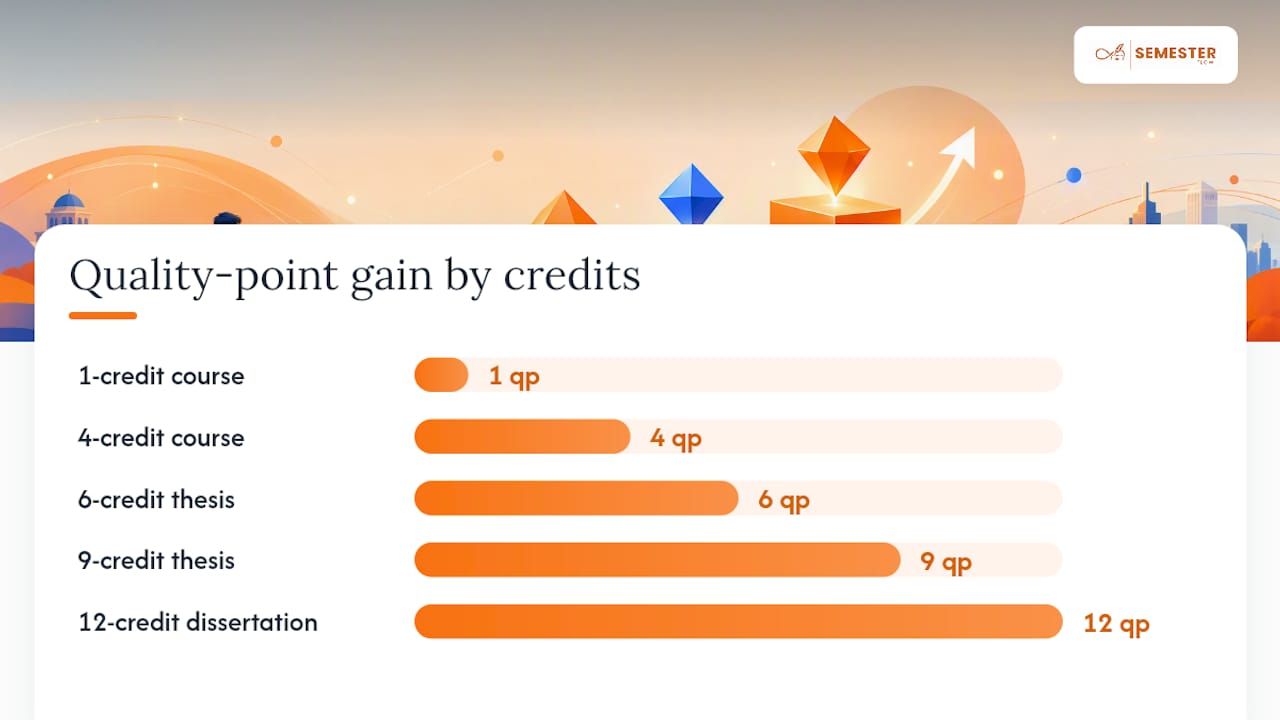
If you're a graduate student, this multiplier gets more dramatic. Thesis or dissertation credits can run 6, 9, or even 12 credits in a single term, which means a weak grade there can drag your GPA far harder than any single graduate seminar would.
Typical credit loads and what they mean for your GPA goals
Full-time undergraduate status commonly begins at 12 credit hours per semester, and most students carry between 12 and 18 credits to stay on pace for a roughly 120-credit degree over four years.
- 12 to 15 credits: A manageable load for most students balancing work, activities, or a demanding major.
- 16 to 18 credits: Common for students trying to graduate early or fit in a double major, but it leaves less room per class for recovery if one course goes sideways.
- STEM and lab-heavy majors: Often carry extra credit weight from lab sections, which can raise your total per semester even when your lecture count looks normal.
More credits mean more quality points at stake every semester. If your GPA is already shaky, a lighter load with more attention per class often protects your average better than cramming in extra credits to finish faster.
Watch for pass/fail, repeats, and transfer credit rules
Not every credit hour on your transcript counts toward GPA the way you'd expect, and the rules differ by school.
- Pass/fail courses: A "P" grade is frequently excluded from GPA math entirely, even though the credits still count toward graduation, according to Baruch College's grading policy.
- Repeated courses: Some schools replace the old grade with the new one in your GPA; others average both attempts. Check your registrar before assuming a retake wipes the slate clean.
- Transfer and quarter credits: Quarter-system credits typically convert at a factor of two-thirds when moving to a semester system, which can shift your credit totals and recalculated GPA.
- A+ grading: Some institutions cap A+ at 4.0, same as a straight A; others award 4.3, which changes your quality-point math on paper even when the letter grade looks identical.
Pro Tip: Before you plan a retake around GPA math, read your school's repeat-course policy directly. "Replacement" and "averaging" produce very different numbers, and assuming the wrong one can throw off your whole semester plan.
Transcripts also sometimes truncate GPA rather than round it, so a small gap between your manual calculation and your official transcript is normal, not a sign you did the math wrong.
Planning ahead: calculators, projections, and tracking tools
A GPA projection calculator takes your current GPA, current credit hours, and planned future credits to estimate the minimum grades you need to hit a target cumulative GPA, according to Calculator.net's GPA tool. Running this early in the semester, not during finals week, gives you time to actually act on what it tells you.
A practical planning routine looks like this:
- Pull your current cumulative GPA and total credit hours from your transcript.
- List your planned courses for the term with their credit hours and a realistic target grade for each.
- Calculate projected quality points and see where you land.
- Identify which class carries the most credit weight and prioritize your study time there first.
- Revisit the projection monthly, not just at midterms, so a slipping grade doesn't surprise you in week 14.
Semester Flow builds this exact workflow into the app instead of leaving it to a spreadsheet. It parses your syllabus to populate deadlines automatically, tracks GPA in real time as grades come in, and flags a class before it quietly drags your average down. The grade projection feature runs the same "what grade do I need" math described above, and the grades cockpit gives you a running view of exactly which course is doing the most damage or the most good.
Pro Tip: Never assume a retake automatically replaces your old grade. Confirm your institution's actual repeat policy before you build a semester plan around it.
What most GPA advice gets backward
Most GPA guides treat every class as equal, then tack on a line about "credit hours matter too" as an afterthought. That's backward. The credit weight of a course should be the first thing you check when deciding where to spend your study hours, not a footnote.
The math is unambiguous: a 4-credit class carries roughly four times the GPA leverage of a 1-credit one. Yet students routinely pour panic energy into a 1-credit elective while ignoring a slipping grade in their heaviest course. If you only have time to triage one class before finals, triage the one with the most credits attached, not the one causing the most anxiety.
The bigger failure in conventional advice is timing. Calculators and projections get framed as end-of-semester tools, something you reach for during a GPA crisis in week 13. That's too late to change much. The real value shows up in week 3 or 4, when a projection can tell you a class is trending toward a grade that will cost you real quality points, while you still have time to adjust study habits, seek a tutor, or talk to a professor. Tools like Semester Flow's real-time tracking exist specifically to close that timing gap, not to replace the math, but to make sure you're looking at it while it still matters.
— Haden
Sources
- Academic standards: calculation (University of Utah)
- Calculate your GPA (University of Illinois registrar)
- Understanding your grades and transcript (Baruch College catalog)