

Email your professors and your academic advisor today, and name exactly which assignments you can finish in the next 72 hours. Instructors have far more flexibility than students assume, and advisors know the petition deadlines that could still save your semester. Sort your remaining work by due date and grade weight before you touch anything else, and only consider dropping or withdrawing after that triage.
TL;DR:
- Contact professors within the first hour with a clear statement of what can be completed and a specific completion date to secure extensions.
- Verify if your course load exceeds 18 credits and whether your GPA and standing require a petition for overload approval.
- Prioritize dropping, withdrawing, or petitioning based on whether a course impacts your graduation timeline, GPA, or financial aid eligibility.
- Use backward scheduling, batch similar tasks, and integrate micro-deadlines into habits to effectively manage a heavy workload.
- Automate syllabus tracking and deadline management with AI tools to avoid scheduling conflicts and stay ahead of missed assignments.
Table of Contents
- Deadline Overload in College: The First 24 to 72 Hours
- What Counts as a Course Overload, and Who Has to Approve It
- Petitioning, Dropping, or Withdrawing: What Actually Happens Next
- Time-Management Tactics That Actually Move the Needle
- Recognizing Burnout Before It Becomes a Bigger Problem
- Should You Keep the Course, Drop It, or Petition? A Fast Decision Framework
- How AI Syllabus Parsing Prevents the Next Overload
- Balancing Your Major, Your Electives, and Everything Else
- Talking to Your Advisor Instead of Just Your Professors
- What Successful Overload Recovery Actually Looks Like
- Why Overload Feels Like a Personal Failure and Isn't
- Prevent the Next Overload Before It Starts
- Where to Verify Your Own School's Rules
- Sources
Deadline Overload in College: The First 24 to 72 Hours
The instinct when three papers and a lab report land in the same week is to panic or freeze. Neither helps. What helps is a short, unglamorous sequence of moves that stops the slide before it turns into a missed final.
- Email every relevant professor within the hour. Keep it three sentences: what's going on, what you can realistically deliver, and a specific proposed date. "I can turn in a full draft by Thursday at 5 p.m." works. "I'm struggling and need more time" does not.
- Rank everything by due date multiplied by grade weight. A 20% final project due in five days outranks a 5% quiz due tomorrow, even though the quiz feels more urgent.
- Block micro-deadlines on your calendar, treating them like actual appointments. Two hours for an outline, ninety minutes for a rough draft, one hour for revisions.
- Turn in partial work when you can't finish. An outline, a bibliography, or a rough draft shows a professor you're engaged, and that visible progress is often what earns you a short extension.
- Loop in your academic advisor if more than two courses are in trouble at once. That's no longer a professor-by-professor problem; it's a course-load problem, and advisors have tools professors don't.
Pro Tip: Advisors consistently note that students who show progress and ask early get more extensions and accommodations than those who wait until the deadline has already passed.
What Counts as a Course Overload, and Who Has to Approve It
Most schools define an overload as a course load exceeding the standard full-time credit limit, which is commonly around 18 credit hours in a semester, though the exact number varies by campus and program. Before you assume you're stuck, check whether you've technically triggered your school's overload policy at all.
- A minimum cumulative GPA is a common gatekeeper for overload approval.
- Good academic standing (no probation, no active disciplinary holds) is usually required alongside the GPA threshold.
- The University of Michigan's LSA policy is a clear example: overloads above 18 credits need a petition and advisor sign-off, not just a click in the registration portal.
- Summer terms, honors programs, and specific majors often carry their own caps that differ from the fall/spring standard.
- Petition windows open and close fast. The Grainger College of Engineering at UIUC sets its cutoff at noon on the tenth day of term, which is typical of how tight these windows can be.
Check your own registrar's page before assuming the 18 credit rule applies to you exactly as described here. Program-level rules can override the general campus policy.
Petitioning, Dropping, or Withdrawing: What Actually Happens Next
These three options aren't interchangeable, and picking the wrong one costs you money, GPA points, or both.
- Drop during the add/drop window and the course disappears from your transcript, no grade attached, but that window closes fast, often within the first two weeks.
- Withdraw after that window and you'll likely see a "W" on your transcript. It doesn't hurt your GPA, but it can affect financial aid completion rates.
- Petition to keep the overload if the course is required for graduation and dropping would just push the problem into a future semester.
- Petitions typically require a rationale statement, your current GPA, and sometimes a signature from the department offering the course. Keep the rationale to a few sentences: why you need the credits and what makes you capable of handling them.
- Overload credits often get billed at the per-credit rate on top of full-time tuition, so check your bursar's page before you commit.
- If you're on federal aid, dropping courses can threaten the completion requirements tied to Title IV eligibility, so talk to your financial aid office before withdrawing from anything.
Time-Management Tactics That Actually Move the Needle
Most study advice is generic. This isn't. These are the tactics that consistently separate students who recover from overload from students who spiral further into it.
- Backward schedule from the final due date. Start at the deadline, work backward, and build in buffer days you're not allowed to use except in emergencies. This is the single highest-yield habit time-management coaches point to, because it exposes bottlenecks weeks before they become crises.
- Batch similar tasks into theme days. Reading-heavy work on Tuesday and Thursday, writing on Monday and Wednesday. Constant context-switching between a chemistry problem set and a literature essay burns more time than the tasks themselves.
- Weigh effort against impact, not just urgency. A discussion post worth 2% of your grade doesn't deserve the same energy as a midterm worth 25%, even if the post is due sooner.
- Stack micro-deadlines onto habits you already have. Fifteen minutes of outlining right after your morning coffee. Ten minutes of flashcard review before you close your laptop at night.
- Run a five-minute weekly check-in every Sunday: what's actually due this week, what slipped, what needs to move up.
- Sync everything into one calendar. Splitting deadlines across a planner, a syllabus PDF, and your memory is how things get missed in the first place.
Campus advice pages consistently point to the same low-tech habits: use your calendar relentlessly, use gaps between classes instead of losing them to scrolling, and plan a week ahead instead of a day ahead. None of it is flashy. All of it works.
Pro Tip: If you're prepping for a licensing or certification exam alongside coursework, the same batching principle applies. Study guides built for structured exam prep use the identical theme-day logic colleges rarely teach explicitly.
Recognizing Burnout Before It Becomes a Bigger Problem
Deadline overload isn't just a scheduling problem. When your workload exceeds what your brain can process, you enter something closer to a survival state, and that state actively impairs planning and decision-making. That's why "just try harder" advice fails when you're already overwhelmed.
Academic stress correlates strongly with lower mental well-being, and some subgroups, including non-binary and second-year students, show even higher strain in surveyed populations. Watch for these signs:
- You can't fall asleep because your brain won't stop cataloging what's due.
- You've started avoiding your email or your learning management system entirely.
- You feel physically sick before opening a specific class's assignments.
If any of that sounds familiar, your campus counseling center, disability services office, or academic success center are built exactly for this moment, not just for crisis situations. Short-term fixes like a genuine ten-minute walk or protecting seven hours of sleep aren't indulgent; they're what restores the executive function you need to actually plan.
Should You Keep the Course, Drop It, or Petition? A Fast Decision Framework
Run through these questions before you make a call you can't easily undo.
- Does this course affect your graduation timeline? If dropping it adds a semester, that's a real cost, but not necessarily the worst one.
- What's your projected grade if you keep going at your current pace? If it's a C when you need a B for your major, the math has already answered the question.
- Will an overload fee or an aid completion rule penalize you for staying enrolled? A few hundred dollars in fees matters less than losing a full semester of financial aid eligibility.
Scenario A: Required course, projected grade is fine, workload is just tight this week. Push through, use backward scheduling, don't drop.
Scenario B: Elective, projected grade is failing, no graduation impact. Drop it before the window closes.
Scenario C: Required course, GPA is borderline, but the professor has already shown flexibility. Petition to stay, and document everything.
How AI Syllabus Parsing Prevents the Next Overload
Everything above works better when you're not manually tracking a dozen syllabi in your head. Semesterflow parses uploaded syllabi and automatically builds a week-by-week schedule, syncing every assignment and exam straight to Google Calendar. Three syllabi become one merged plan with real due dates instead of three separate PDFs you have to cross-reference at 11 p.m.

The grades cockpit flags a slipping course before it becomes a crisis, which is the automated version of the GPA-weighted prioritization covered earlier. Micro-deadlines you'd otherwise set manually get protected on your calendar automatically, turning backward scheduling from a discipline problem into a default setting.
Balancing Your Major, Your Electives, and Everything Else
Not every course deserves equal weight, and treating them that way is part of what causes overload in the first place. Your major requirements and any prerequisite-heavy courses should get first claim on your best hours and your sharpest thinking, since a weak grade there can block you from advancing or hurt your standing with grad programs or employers.
Electives are where you have room to breathe, but only if you actually treat them as lower-stakes. That means resisting the urge to over-invest in a class you're taking purely for interest while your core major course slides. A practical split: front-load your week with major coursework when your energy is highest, typically the first two or three days after a weekend reset, and push electives and general education requirements into the back half of the week when your focus naturally dips.
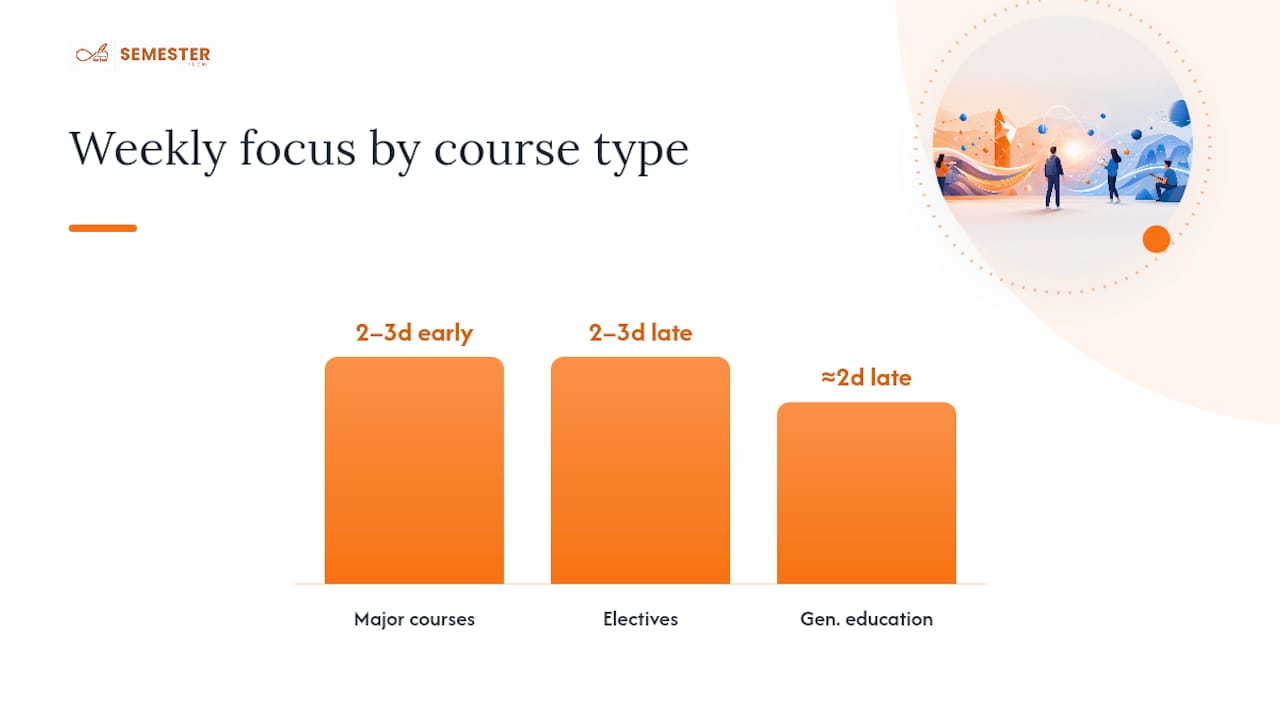
If you're consistently overloaded, look at your course mix, not just your total credit count. Four heavy-writing courses in one semester will wreck you even if the credit total looks manageable, because the workload isn't distributed by credit hours; it's distributed by output type. Mixing a lab science, a discussion-based seminar, a project-based course, and one lecture-heavy class spreads the demands across different skills and different weeks, so you're rarely hitting five deadlines of the exact same type at once. When you register for next semester, ask your department not just "does this fit my schedule" but "does this compete with my other courses for the same kind of work."
Talking to Your Advisor Instead of Just Your Professors
Professors handle individual course problems. Advisors handle the bigger picture, and that distinction matters more than most students realize until they're already behind in four classes.
Come to an advising appointment with specifics, not vague distress. "I'm overwhelmed" gets a sympathetic nod and generic advice. "I have four courses with major deadlines in the same ten-day window, and my GPA is at 2.9, right at the line for probation" gets a concrete plan, because it hands the advisor something they can actually act on.
Ask direct questions: What are my options if I drop this specific course? Does withdrawing from this class affect my financial aid this semester? Is there a lighter-load path to my degree that doesn't cost me an extra year? Advisors deal with these questions constantly and usually have workarounds that never make it onto the general FAQ page.
Follow up by email after any verbal conversation, restating what you discussed and agreed on. That written record protects you if a petition or an appeal comes up later, and it keeps the advisor accountable to what was actually promised.
What Successful Overload Recovery Actually Looks Like
The students who recover from a bad stretch of deadlines rarely do anything dramatic. They do the boring stuff early and consistently.
A common pattern: a student hits week seven with three overlapping projects and a failing quiz grade in one class. Instead of pulling an all-nighter, they email all three professors the same day, proposing staggered submission dates instead of the original identical deadline. Two professors agree immediately. The third asks for a partial draft first, which the student had already prepared because they'd triaged by grade weight the night before.
Another pattern shows up around the petition process itself. A student realizes in week three that a required course conflicts directly with two others, credit-wise pushing them past 18 hours. They don't wait. They pull their GPA, draft a two-sentence rationale, and submit the petition inside the window instead of after it closes, which is often the actual difference between approval and rejection, not the strength of the argument itself.
The pattern that shows up in almost every recovery story is the same: act inside the window, document what you did, and treat the advisor relationship as an ongoing conversation, not a last resort.
Why Overload Feels Like a Personal Failure and Isn't
Most students treat deadline overload as evidence they're bad at college. That's backwards. Overload is usually a scheduling and communication failure, not a character flaw, and the students who recover fastest are the ones who stop moralizing about it and just start triaging.
The bigger mistake I see in overload advice generally is treating an extra semester as a disaster to avoid at all costs. Sometimes taking five years instead of four is the correct trade against tanking your GPA or burning out completely, and advisors will tell you that directly if you ask.
One tactical thing worth doing regardless of which path you choose: negotiate with specific proposed dates, not vague requests for more time, and keep a copy of every petition and every approval email you receive. Departments lose paperwork. Your inbox shouldn't.
— Haden
Prevent the Next Overload Before It Starts
Semesterflow turns the triage tactics above into something that runs in the background instead of something you have to rebuild every semester by hand. Upload your syllabi, and the AI extracts every deadline, exam, and assignment weight, syncing it straight to Google Calendar so nothing gets missed between three different course pages.

The grade projection feature shows you exactly what score you need on remaining work to hit your target grade, which turns the "should I drop this course" decision from a guess into a calculation. Students juggling a heavy major course load, or parents keeping an eye on a first-year student's progress, tend to get the most out of the real-time risk alerts. Start a free trial at Semesterflow and upload your next syllabus before the semester gets ahead of you.
Where to Verify Your Own School's Rules
Policy specifics vary by campus, so confirm details directly with your institution. Start with your registrar's overload policy, your school's petition portal, your degree catalog for program-level credit caps, and your bursar's page for overload fee structures.