

The two most reliable signs you're failing a class are a drop in attendance and a pattern of missed deadlines, not a bad grade itself. If you notice either, the immediate move is to check your current standing against the syllabus, email your professor today, and book help before the week ends.
TL;DR:
- Declining attendance and LMS engagement often appear weeks before grades reflect failure, making behavioral warning signs critical for early intervention.
- Focus on assessments with high weights in the syllabus, as missed or late work on major assignments significantly increases failure risk compared to minor quizzes.
- Early predictive models can identify 87% of at-risk students by week 5 using quiz scores and platform activity, despite a high false positive rate.
- Acting within weeks 3 to 4 offers the best chance to reverse a downward trend before midterms, while delays greatly reduce intervention options.
- Understanding your institution’s drop, withdrawal, and retake policies can influence whether to exit a failing course, with withdrawals not affecting your GPA.
Table of Contents
- Failing a Class Signs to Watch in Your Behavior
- Academic Indicators That Point to a Failing Grade
- What the Research Says About Catching This Early
- Your Action Plan If You're Seeing These Signs
- Understanding Drops, Withdrawals, and Retakes
- Spotting the Slide Before It Becomes a Transcript Problem
- A Failing Grade Is Diagnostic, Not a Verdict
- Try Semester Flow Before Your Next Grade Check
- Sources
- FAQ
Failing a Class Signs to Watch in Your Behavior
Grades lag behavior by weeks. By the time a transcript shows the damage, the real story already played out in attendance logs and login activity. That's why behavioral warning signs of failing matter more than any single grade.
Attendance and learning-management-system engagement drop first, usually before a student even admits something is wrong. Skipping two classes in a row, or logging into Canvas or Blackboard less often, is often the earliest visible marker of academic struggle. Researchers who build early-warning systems for schools call this the "ABC" model: absenteeism, behavior, and course performance, tracked in that order because absenteeism typically surfaces first.
Social and physical changes tend to follow close behind. Watch for:
- Withdrawing from study groups or group chats you used to be active in
- Sleeping through morning classes or losing your appetite around exam weeks
- Feeling foggy or unable to concentrate during lectures you once followed easily
- Making vague excuses instead of naming the actual problem to friends or family
Avoidance is the tell that separates a rough week from a real slide. Skipping office hours you'd normally attend, dodging a professor's email, or quietly hiding a missed quiz from yourself are all forms of the same behavior: postponing information you don't want to face.
Pro Tip: Set a recurring weekly reminder to check your LMS activity dashboard. A sudden dip in your own login frequency is a signal most students only notice in hindsight.
Academic Indicators That Point to a Failing Grade
Not every low score means the same thing. A single missed quiz worth 2% of your grade is a blip. The signs of poor grades that actually matter are the ones tied to heavily weighted assessments.
Repeated late or missing work does more damage than occasional low scores, because most professors treat a zero as a permanent hole rather than a recoverable dip. One bad exam can be offset by a strong final. A stack of missing homework usually cannot.
Before you panic, pull out your syllabus and check:
- Which categories (exams, papers, participation) carry the most weight toward your final grade
- Whether your professor drops a lowest score or offers extra credit anywhere
- How many points remain on the table for the rest of the term
- Whether your current trend line is flat, dipping, or in free fall across the last three assessments
Here's the trend that should worry you most: a logistic regression model built on real course data found that repeated withdrawals from other courses carried nearly four times the odds of eventual failure compared to students without that pattern, and late assignments carried triple the odds, according to research on behavioral predictors of academic risk. GPA decline alone was a much weaker predictor by comparison.
What the Research Says About Catching This Early
Academic failure isn't unpredictable. It follows a pattern detectable early enough to act on, if you know where to look.
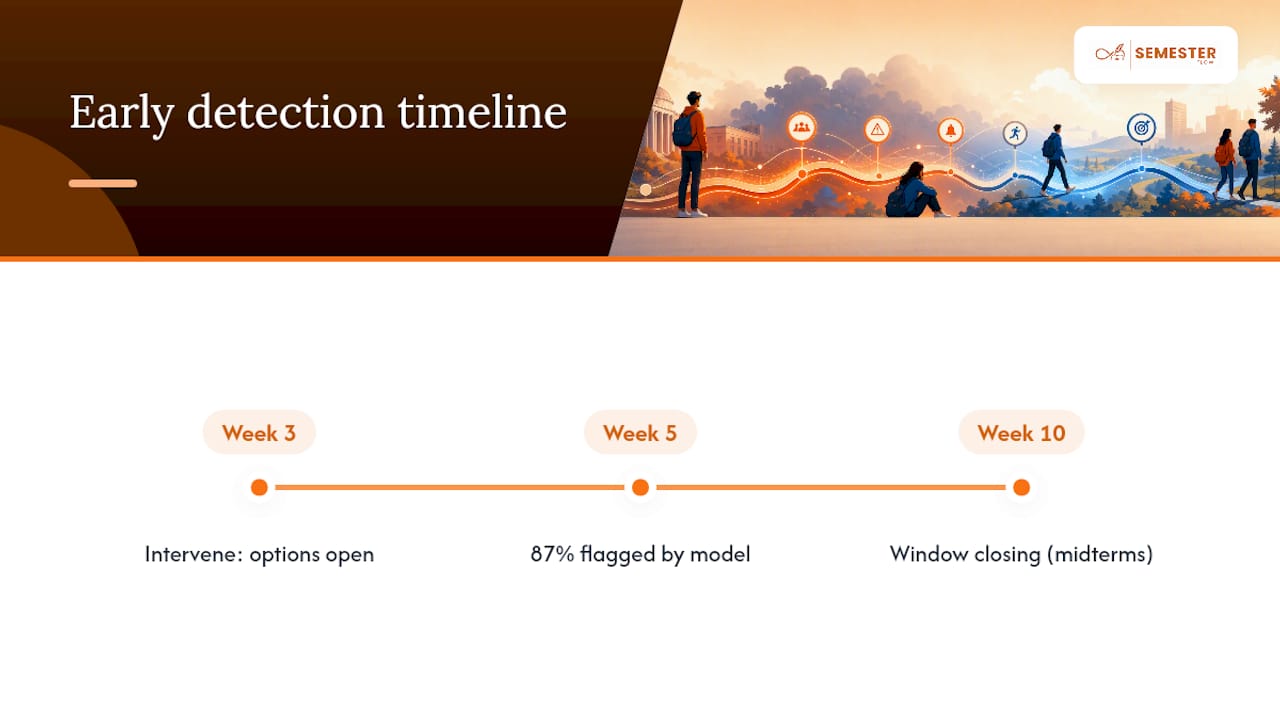
A machine-learning model built on assessment momentum and LMS interaction logs identified 87% of eventually failing students by week 5 of the term, using nothing but early quiz scores and platform activity. That predictive power came with a tradeoff: a 41% false positive rate, meaning plenty of students flagged as "at risk" go on to pass just fine.
That tradeoff actually works in your favor. Checking in with a professor or a tutor when you didn't strictly need to costs you almost nothing. Missing the window when you did need help costs you the class.
Behavioral markers like attendance decline and repeated withdrawals substantially outperform GPA as early predictors of failure, and they open a 4 to 8 week window where intervention still changes the outcome.
That window starts to close around midterms. Acting in week 3 gives you options that simply don't exist by week 10.
Your Action Plan If You're Seeing These Signs
Treat this like triage, not a to-do list you'll get to eventually. Work through it in order.
- Calculate your actual standing. Pull up the syllabus grading breakdown and figure out the exact score you need on remaining assignments to pass. Vague dread is worse than a real number.
- Email your professor today, not after the next exam. Keep it short: "I'm concerned about my grade in [class]. Can we discuss my options, including extra credit or extensions?" Most instructors respond better to early, direct outreach than to a plea after finals week.
- Book campus support this week. Tutoring centers, writing centers, and counseling offices all fill up fast near midterms. A session booked today beats one booked after the next bad grade.
- Restructure your studying into short, high-yield blocks. Twenty-minute sessions of retrieval practice, focused only on the assessment categories that carry the most weight, beat a single unfocused all-nighter.
Pro Tip: Bring a specific number to your professor meeting, not a vague worry. "I need an 82 on the final to pass" opens a real conversation. "I'm behind" invites a generic response.
Understanding Drops, Withdrawals, and Retakes
Once you know where you stand, it helps to know what your institution actually allows. The terminology gets confused constantly, and the differences matter for your transcript.
- A late drop removes the class from your record entirely, but most schools cut off this option a few weeks into the term.
- A withdrawal (W) stays on your transcript but doesn't factor into your GPA. It signals you left the course, not that you failed it.
- An incomplete (I) buys you extra time to finish coursework, usually reserved for documented emergencies rather than a bad midterm.
- An F stays and counts, though it's often replaceable later.
Most colleges allow undergraduates to retake a failed class](https://facassembly.uccs.edu/sites/g/files/kjihxj2066/files/inline-files/FAQs_Grade_Forgiveness_Handout_021420.pdf), though whether the new grade fully replaces the old one in your GPA calculation depends entirely on your school's policy. Check the deadline for whichever option you're considering. Documenting a medical or family emergency for an incomplete request usually goes through your registrar, and federal privacy rules govern how that paperwork gets handled.
Spotting the Slide Before It Becomes a Transcript Problem
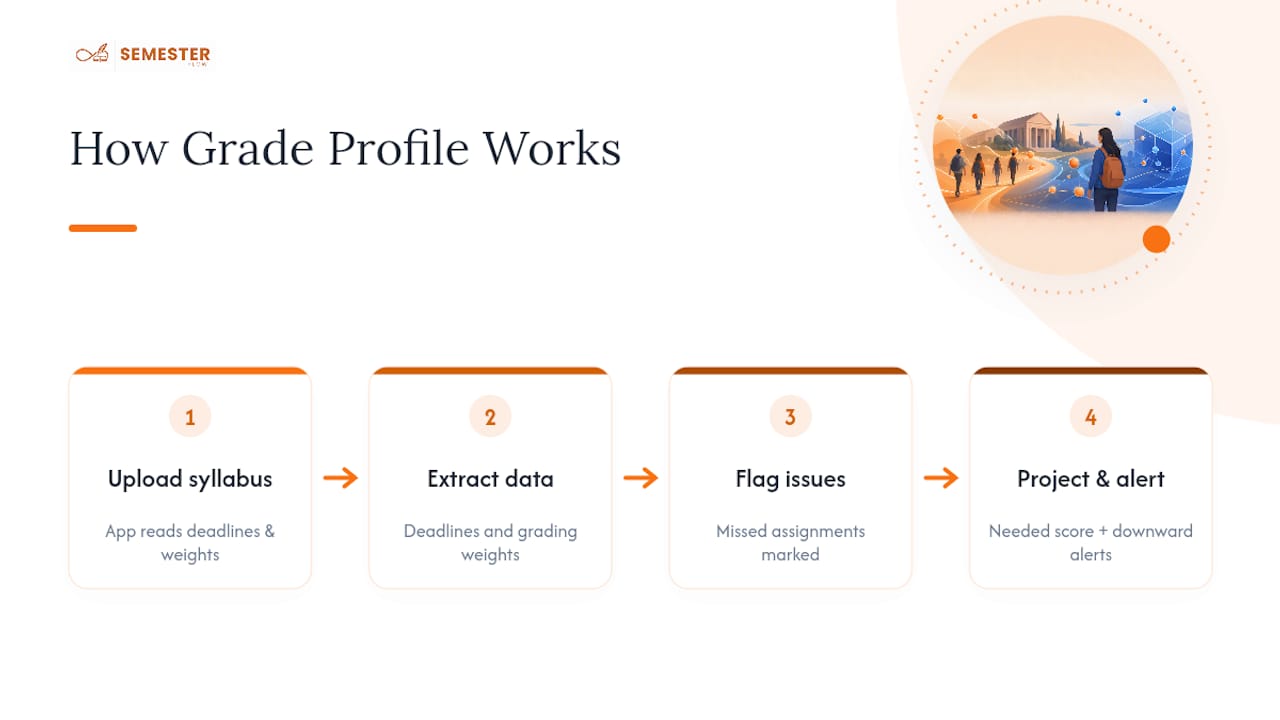
Catching these signs manually means checking a syllabus, a gradebook, and your own memory of what's due, across every class, every week. That's exactly the gap Semester Flow's grade profile feature is built to close. Upload a syllabus and the app extracts every deadline and grading weight automatically, so a missed assignment shows up as a flag rather than something you notice three weeks later.
Per-class grade profiles track your real-time GPA trend and project what score you need on remaining work to pass, the same calculation recommended above, done automatically. Combined with alerts on courses trending downward, it turns "I have a bad feeling about this class" into a specific number and a specific next step.
A Failing Grade Is Diagnostic, Not a Verdict
Failing a class tells you something changed, not that you lack the ability to succeed. The students who recover fastest aren't the smartest ones in the room. They're the ones who act on the first warning sign instead of the fifth.
— Haden
Try Semester Flow Before Your Next Grade Check
Semester Flow is the alternative to tracking deadlines across five separate syllabi in your head. Upload each syllabus once and the AI extracts every assignment, exam, and grading weight, then syncs it straight to your Google Calendar so nothing slips through by accident.

Where the app earns its keep is the part manual planners can't do: grade projection that calculates exactly what score you need on what's left, and alerts that flag a course trending toward failure before you'd catch it yourself. The Free Trial gets you started at $0 per month, and the Pro plan runs $7.99 per month for full access to grade tracking and document organization. If you're a parent who wants visibility into a student's standing, the Parent plan is $15 per month. Upload your first syllabus and see your current grade projection before your next assignment is due.
Sources
For deeper detail on the research and policies referenced above, see the predictive modeling study on early failure detection, the behavioral predictors research, BestColleges' guide on failing a class, and the grade forgiveness policy summary.
- Which CS1 Students Will Fail? Identifying Digital Markers from Learning Analytics in Computer Systems and Architecture Using Weighted Academic Momentum and Interaction Logs
- Crisis to Prevention: Machine Learning Reveals Behavioral Predictors Outperform GPA in Early Student Risk Detection
FAQ
What Are the Early Warning Signs of Failing a Class?
The clearest early signs are declining attendance, reduced LMS activity, and repeated late or missing assignments, all of which tend to appear weeks before your GPA visibly drops. Predictive models built on these markers can flag most eventually failing students by week 5 of the term.
Will I Fail 7th Grade With Two F's?
Two failing grades don't automatically mean failing the entire grade level. Most schools evaluate promotion based on overall credits and specific required courses, so check with your school counselor about which classes are mandatory for advancement.
Will One C Ruin My GPA?
A single C rarely does last damage to an otherwise strong GPA, especially over a full college career with many courses. It matters more if that C sits in a heavily weighted or required course, or if it's part of a broader downward trend rather than an isolated dip.
Is a 0.7 GPA Bad?
A GPA well below the minimum threshold most colleges require for good academic standing typically triggers academic probation. If your GPA has fallen this low, meeting with an academic advisor immediately is more urgent than any single class strategy, since multiple courses are likely involved.
What Should I Do the Moment I Suspect I'm Failing a Class?
Check your actual standing against the syllabus grading breakdown, then email your professor the same day to ask about your options. Following up quickly with tutoring or your school's academic support resources makes the biggest difference during the 4 to 8 week window when intervention still works.