

The winning approach to finals week is simple to state and hard to fake: build short, realistic study blocks around active practice, and protect a recommended amount of sleep every night no matter what. Do these three things in the next 10 minutes and the rest of the week gets easier. First, write down every exam's date, time, and weight in one place. Second, rank your exams and assign your top three study blocks to whichever ones are hardest or worth the most. Third, block out sleep windows on your calendar like they're unmovable appointments, because they are.
- Front-load your hardest subject while your brain is freshest, usually the first two or three days.
- Reserve the final 24 hours before each exam for review only. No new material.
- If a study block gets skipped, add a little extra time the next day instead of pulling an all-nighter.
Table of Contents
- Ten-Minute Finals Week Checklist
- How to Build a Realistic Finals Week Schedule
- Study Methods That Actually Move the Needle
- Handling Back-to-Back Exams and Heavy Course Loads
- Protecting Sleep and Building in Recovery
- How Semester Flow Automates the Logistics So You Can Focus on Studying
- What Most Finals Advice Gets Backward
- Let Semester Flow Handle the Setup While You Handle the Studying
- Sources
Ten-Minute Finals Week Checklist
Before you build anything elaborate, clear the administrative clutter that causes last-minute panic.
- List every exam with date, time, location, and grade weight in a single document or spreadsheet.
- Pack your materials now: student ID, calculator, chargers, any permitted notes or formula sheets, printouts.
- Handle day-before logistics: confirm the exact room, set two alarms, and prep a short "emergency topics" list of your three weakest areas per subject.
- Note support windows: office hours, tutoring center slots, and any study group meeting times, so you're not scrambling to find help on day three.
Pro Tip: Keep your emergency topics list to five bullet points per exam, max. If you can't summarize your weak spots in five lines, you haven't actually diagnosed them yet.
How to Build a Realistic Finals Week Schedule
Start by ranking exams on three axes: how soon they land, how much they're worth, and how hard the material actually is for you personally. A cumulative final worth 30% of your grade in a class you're already struggling in outranks a 10% quiz you could pass half asleep. Once you know the order, work backward from each exam date through three phases: initial learning (closing knowledge gaps), deep practice (timed self-testing), and review-only (the final day, no new material).
The Cornell Learning Strategies Center's five-day study plan is a good skeleton to build from. It splits material into chunks, then alternates preparing new chunks with reviewing older ones, using self-testing throughout instead of passive rereading.
A sample five-day layout for one heavy exam:
- Day 1: Prepare chunks 1 and 2 (about 2 hours each).
- Day 2: Prepare chunk 3, review chunk 1 with self-testing.
- Day 3: Prepare chunk 4, review chunks 2 and 3.
- Day 4: Full review of all chunks, timed practice questions.
- Day 5: Light review only, focus on weak spots flagged from Day 4.
Cap your daily focused study time around 6 hours. The University of Pennsylvania's Weingarten Center points out that schedules built on unrealistic daily totals tend to collapse by day two, taking your motivation with them. Build in at least one buffer block per day, roughly 30 to 45 minutes, so a slow start or a confusing topic doesn't derail everything after it.
Study Methods That Actually Move the Needle
Rereading your notes feels productive. It mostly isn't. Johns Hopkins Academic Support is direct about this: active methods that force retrieval, like flashcards, blank-page recall, or explaining a concept out loud without looking at your notes, expose gaps that passive rereading hides. If you can't reconstruct the material from memory, you don't know it yet, no matter how many times you've read it.
Build each study block around these tactics:
- Flashcards or blank-page tests for anything memorization-heavy.
- Old exams and problem sets run as timed exam simulation, not open-book warmups.
- Teaching the material aloud to a roommate, a study partner, or an empty room.
- Interleaving subjects rather than mastering one and moving on. Cornell's research notes that rotating between subjects and alternating prep with review strengthens long-term retention compared to grinding one topic in isolation.
Statistic Callout: Protecting sleep the night before an exam is tied to a 20 to 40% improvement in memory retention, which matters just as much as how you study, not instead of it.
Structure each session in three parts: a brief prime (10 to 15 minutes reviewing prior notes), 40 to 60 minutes of active practice, then 10 minutes of gap analysis where you write down exactly what you got wrong. That last step is the one most students skip, and it's the one that tells you what to study tomorrow.

Handling Back-to-Back Exams and Heavy Course Loads
Four finals in three days sounds impossible until you stop trying to give each subject a full day.
- For back-to-back exams, finish the heavy lifting two days out and use the final 24 hours only for targeted review of your weak spots. New material in that last day tends to create confusion rather than clarity.
- With four or more finals, assign subjects to specific days in rotation rather than devoting whole days to a single class. Short, frequent blocks beat one marathon session per subject.
- If you're starting late, triage. Rank by what's recoverable and what carries the most grade weight, then pour your remaining hours into high-yield active practice instead of trying to cover everything.
- If you miss a block, add a modest amount of extra time the next day. An all-nighter to compensate usually costs you the sleep you need to actually remember what you crammed.
Pro Tip: Match your method to the exam format. Closed-book tests reward timed practice under real constraints; memorization-heavy finals reward spaced recall; essay exams reward outlining under a clock.
Protecting Sleep and Building in Recovery
Sleep isn't a reward for finishing your studying. It's part of how studying works. Quality sleep the night before an exam is linked to a 20 to 40% jump in memory retention, and cognitive function during the exam itself depends on getting at least 6 to 7 hours consistently through the week, not just the night before.
A few rules make this easier to hold onto:
- Stop learning new material 24 hours before each exam. Use that window for consolidation only.
- Set a screen curfew and a short wind-down routine, even 15 minutes helps signal your brain that the day is closing.
- Take a 10 to 15 minute break every 50 to 60 minutes of studying. Walk around, stretch, get away from the desk.
- Eat real meals on a schedule. Skipping lunch to "get through one more chapter" usually backfires by 3 p.m.
How Semester Flow Automates the Logistics So You Can Focus on Studying
Every tactic above depends on knowing your exam dates, weights, and deadlines accurately, and that's usually where finals week planning falls apart before it starts. Semester Flow is built around removing that friction. Upload your syllabus and it parses class schedules, assignments, and exam dates automatically, syncing everything straight to Google Calendar instead of leaving you to transcribe a dozen PDFs by hand.
Here's how the features map directly onto the planning steps above:
- Syllabus parsing turns scattered exam dates and weights into a single accurate list, the exact first step this article recommends.
- Calendar sync makes it easy to block realistic study sessions and buffer time around fixed commitments instead of guessing at your own availability.
- Real-time GPA tracking flags which courses actually carry the most impact on your final grade, so your top three study blocks are based on data instead of a hunch.
Students juggling four or five finals rarely have spare time to build a schedule by hand. Automating the setup gives that time back for the part that actually moves your grade: active practice.
| Point | Details |
|---|---|
| Prioritize by impact | Rank exams by date, grade weight, and personal difficulty before building any schedule. |
| Use active recall | Flashcards, blank-page tests, and timed practice questions outperform rereading notes. |
| Protect sleep every night | Aim for 6 to 7 hours nightly; the night before an exam matters most for memory retention. |
| Cap daily study hours | Keep focused study around 6 hours a day with buffer blocks to absorb setbacks. |
| Automate the setup | Semester Flow parses your syllabus and syncs deadlines to Google Calendar so planning takes minutes, not hours. |
What Most Finals Advice Gets Backward
Most finals week advice treats sleep as the thing you sacrifice when you run out of time, and treats scheduling as an hour-by-hour script you're supposed to follow exactly. Both assumptions are wrong. Sleep is a performance input, not a reward, and the 20 to 40% swing in memory retention tied to it should outrank almost any other tactic on this page.
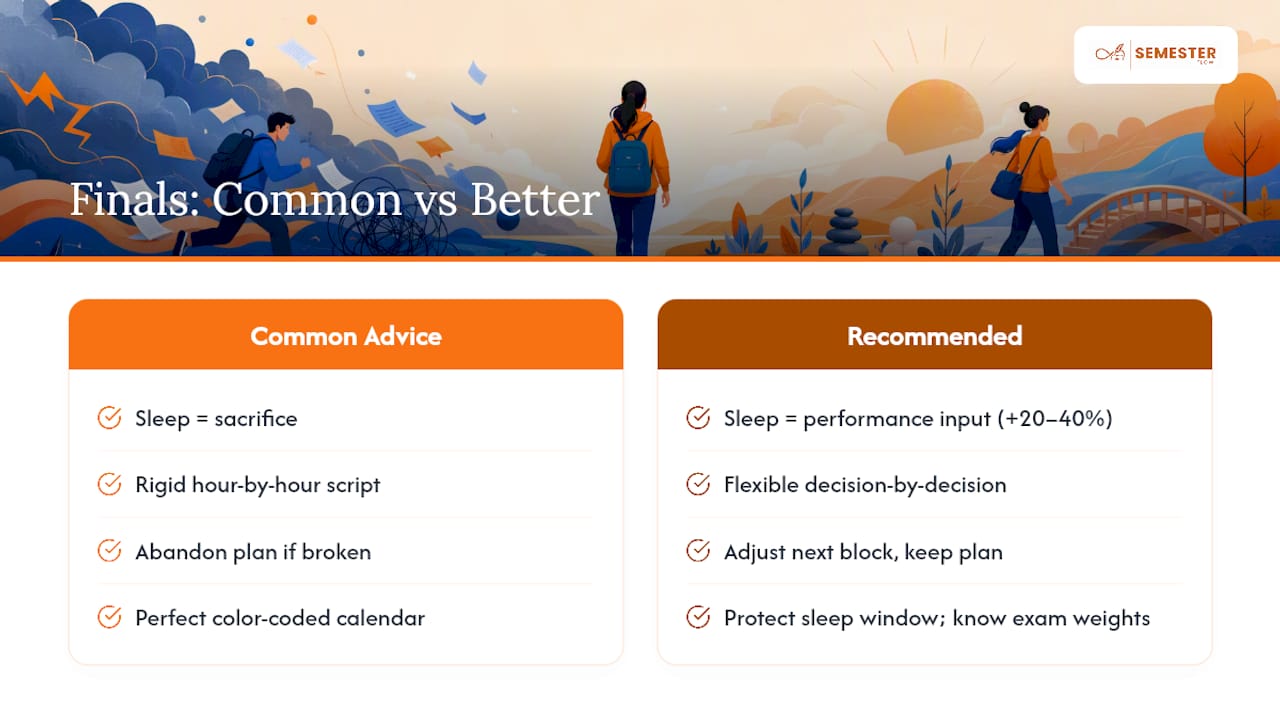
The rigid hour-by-hour schedule fails for a more practical reason: it breaks the first time life interferes, and then students abandon the whole plan instead of just the one broken block. Treating your schedule as a sequence of decisions, what's next, given what actually happened, holds up far better than a fixed script ever does.
If you take one thing from this article, take this: spend your planning energy on knowing your exam weights accurately and protecting your sleep window, not on building the perfect color-coded calendar. The calendar can be automated. The judgment about what matters most cannot.
— Haden
Let Semester Flow Handle the Setup While You Handle the Studying
Building a finals-week schedule by hand means digging through five syllabi, cross-referencing due dates, and hoping you didn't miss a weight percentage buried on page three. Semester Flow skips that entirely: upload your syllabus and it extracts your exam dates, assignment deadlines, and grade weights automatically, then syncs the whole thing to Google Calendar.

That means the ranking work this article walks through, sorting exams by date, weight, and difficulty, happens with real numbers instead of guesswork. The grade projection feature shows you exactly what score you need on each remaining final to hit your target GPA, so your top three study blocks are based on what actually moves your grade. Pair that with document organization synced to Google Drive and your study guides, old exams, and notes stay in one place instead of scattered across three apps.
If you're heading into finals with more exams than hours, start by uploading your syllabus to Semester Flow and let it build your exam calendar before you write a single study block by hand.
Sources
- Memory and learning — UCSB Wellness
- Active versus passive learning — Johns Hopkins Academic Support
- Five-Day Study Plan — Cornell Learning Strategies Center
- How to create a finals-week study plan — University of Pennsylvania (Weingarten Center)