

The most effective system is simple: run scheduled grade checks two to three times a semester, assign one officer to own the process, and use a shared dashboard that flags anyone below your chapter's GPA threshold. A tool like Semester Flow can automate the tracking side, but the structure matters more than the software. Start this semester with a single baseline grade check for every member.
TL;DR:
- Most chapters should conduct three to four GPA checks per semester, timed before and after midterms and finals, to catch issues early and support at-risk members.
- Assign a dedicated Scholarship Chair to oversee data collection, reporting, and handoffs, supported by an academic review committee and a clear documentation process.
- Use verified sources like signed grade sheets or official campus rosters to minimize data falsification, restricting access based on officer roles to maintain privacy and integrity.
- Implement tiered interventions with quick follow-ups for members below GPA thresholds, requiring evidence-based updates and support plans to promote genuine improvement.
- Automating tracking through tools like Semester Flow streamlines data management, reduces officer hours, and provides real-time GPA monitoring and early warning features.
Table of Contents
- Fraternity Grade Tracking Checklist For This Semester
- How To Build A Chapter Tracking System That Survives Officer Turnover
- Manual, Semi-Automated, Or Automated: Choosing Your Fraternity Academic Monitoring Workflow
- Tiered Interventions: What Happens When A Member Falls Below Threshold
- Handling Privacy And Consent In Academic Monitoring
- Measuring Chapter Performance: Metrics That Actually Mean Something
- What I Learned Running Grade Checks As A Chapter Officer
- Let Semester Flow Handle The Tracking So Officers Can Handle The People
- Templates And Policy References Worth Borrowing
- Sources
- FAQ
Fraternity Grade Tracking Checklist For This Semester
Before you build anything elaborate, get these four pieces in place. This is the version you can hand to your executive board this week.
- Appoint your team. Name a Scholarship Chair, form a small Academic Review Committee, and add a faculty or alumni advisor as a liaison for accountability.
- Set your thresholds. Publish a minimum cumulative GPA for general membership (commonly 2.5) and a higher bar for officers (commonly 2.75), echoing standards used in Lehigh University's academic accountability policy.pdf).
- Lock the calendar. Schedule grade checks before midterms, right after midterms, and again before finals.
- Define your triggers. Decide now what counts as "at risk" (a C or below in any class, or falling under the chapter minimum) and what happens next.
That's the whole skeleton. Everything else in fraternity grade tracking is refinement.
How To Build A Chapter Tracking System That Survives Officer Turnover
Most chapters do not fail at grade tracking because they lack a spreadsheet. They fail because the spreadsheet lives in one outgoing officer's head, and the next Scholarship Chair inherits a file nobody can interpret. A durable system separates roles clearly and documents the handoff before it's needed, not after.
Give the Scholarship Chair ownership of the process end to end, but split the workload:
- The Scholarship Chair runs the calendar, collects data, and reports to the executive board.
- The Academic Review Committee, ideally including an advisor, meets after each grade check to review flagged members.
- A secretary or data officer maintains the actual records so the system does not depend on one person's memory.
For cadence, three checkpoints per semester works well for most chapters: one before midterms to catch early slides, one right after midterms when grades are freshest, and one before finals to set expectations going into exam season. This mirrors grade-check timing recommended in practitioner best-practice guides.
Every member record should track previous semester GPA, current major, a personal goal GPA, and a running log of any interventions assigned. Without that history, you're guessing whether a member is improving or just having one bad week.
Pro Tip: Build your handoff document before the current Scholarship Chair graduates, not after. A one-page "how this works" guide saves the next officer weeks of confusion.
Manual, Semi-Automated, Or Automated: Choosing Your Fraternity Academic Monitoring Workflow
Small chapters with under 40 members can often get away with manual tracking. Larger chapters usually can't, and pretending otherwise is how tracking systems quietly die.
- Manual verification relies on signed grade sheets, sometimes with faculty sign-off. It's cheap and simple, but it depends entirely on member honesty and someone's willingness to chase down forms every few weeks.
- Semi-automated tracking pulls from campus academic rosters or scheduled exports from the registrar, when your university allows it. This cuts down on self-reporting bias but still needs a human to compile and interpret the data.
- Automated tracking uses AI to parse syllabi, extract grading policies, and sync deadlines directly, the approach Semester Flow takes, while apps built specifically for Greek organization chapter management offer similar screenshot-parsing and GPA dashboards.
Chapters that combine official rosters with a standard reporting form reduce data errors at officer transitions, compared with chapters running purely ad-hoc spreadsheets passed down year to year.
Whatever workflow you choose, restrict visibility by role. The Scholarship Chair and Academic Review Committee should see individual grades; the general chapter should only see aggregate numbers. That single rule prevents most of the misuse complaints that make members stop reporting honestly.
Tiered Interventions: What Happens When A Member Falls Below Threshold
A grade-check system without consequences is just a newsletter. The interventions are where fraternity performance evaluation actually changes outcomes.
- Flag the trigger. Any class at a C or below, or a cumulative GPA under your chapter minimum, moves a member into the review tier.
- Meet within one week. The Scholarship Chair or a committee member sits down with the flagged member, not to lecture, but to build a plan: tutoring referral, a meeting with the professor, or a structured study-hour schedule.
- Require biweekly evidence. Ask for scanned quiz scores, a tutor log, or a short professor check-in, not just a verbal "I'm doing better." This mirrors the progress-verification approach recommended by Sigma Nu's scholarship best practices.
- Adjust the plan. If two check-ins show no movement, escalate to more structured mandatory study hours or reduced social privileges, depending on your bylaws.
- Recognize improvement publicly. A shoutout at chapter meeting, a small scholarship fund reward, or a spot on an honor roll costs nothing and reinforces that the system rewards effort, not just punishes failure.
Pro Tip: Track the recovery cases as carefully as the flagged ones. A member who climbs from a 2.3 to a 3.1 in one semester is your best recruiting story for why the system works.
Handling Privacy And Consent In Academic Monitoring
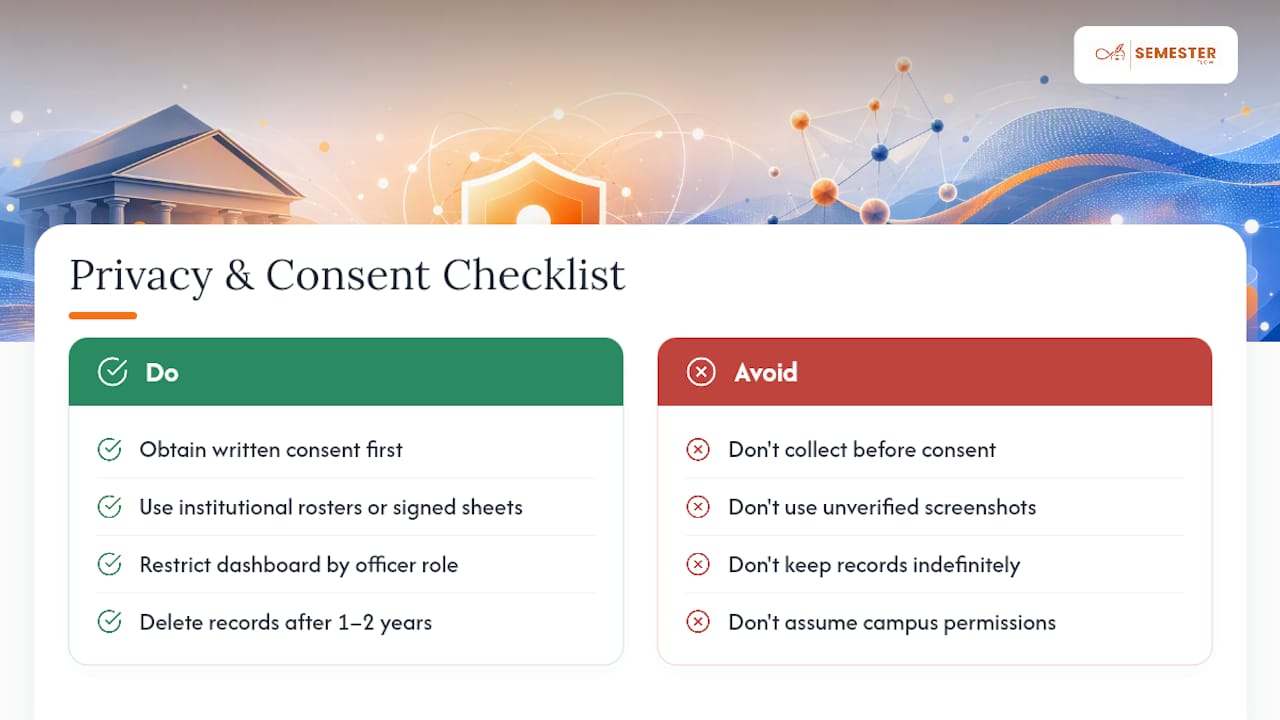
Get written consent from every member explaining exactly who sees their grades and why, before you collect a single data point. Favor institutional rosters or signed grade sheets over unverified screenshots whenever your campus allows access, since self-reported images are easiest to falsify. Restrict dashboard visibility strictly by officer role, and set a policy to delete old academic records after a defined period, typically one to two years. When in doubt about what your university permits regarding student academic records, check your school's registrar or student affairs office before building anything permanent.
Measuring Chapter Performance: Metrics That Actually Mean Something
Raw GPA numbers tell you less than you'd think without context. A 3.1 chapter average sounds fine until you learn the campus-wide average is 3.4.
Track these core numbers every semester:
- Chapter cumulative GPA and current semester GPA
- Percentage of members above your target threshold
- Percentage currently flagged as at risk
- Trend line comparing your chapter to the campus or Greek-life average
Syracuse University's public Greek Life grade reports show a useful model: semester and cumulative GPA reported side by side per chapter, letting members see exactly where they rank against peer organizations. Report internally on a monthly basis to the executive board, and produce a formal semester report for the full chapter and, if required, your national organization. A simple trend line plus a table of at-risk members, broken out by class year, covers most of what members actually want to see.
What I Learned Running Grade Checks As A Chapter Officer
The hardest part of fraternity academic monitoring was never the spreadsheet. It was the handoff between officers, every single time. A dashboard someone can actually read on day one beats a brilliant system only the outgoing chair understood. Small, consistent checks every few weeks caught more struggling members than any dramatic end-of-semester audit ever did. The chapters that treat this as support, not surveillance, get better participation and better grades.
— Haden
Let Semester Flow Handle The Tracking So Officers Can Handle The People
Every workflow above works, but manual grade checks eat hours that a Scholarship Chair could spend actually meeting with at-risk members instead of chasing down forms. Semester Flow is built for exactly that gap: it parses syllabi automatically, syncs every deadline to Google Calendar, and gives each member a live Grade Profile that tracks GPA in real time instead of waiting for the next scheduled check.

The Grade Goal Projection feature flags a slumping grade before it becomes a semester-ending problem, and the Grades Cockpit gives officers one dashboard view across the whole chapter roster, which solves the handoff problem directly since nothing lives in one outgoing officer's personal files. Chapters can start with a free trial, and organization-wide access is available for chapters that want every member onboarded under one shared system. Check the pricing page to see which plan fits your chapter's size.
Templates And Policy References Worth Borrowing
- Syracuse University's Greek Life grade reports for chapter reporting layout.
- Sigma Nu's Intellectual Development Action Plan for a study-hour tracking template.
Sources
Verified sources, like signed grade sheets or campus rosters, beat self-reported screenshots because they remove the temptation to misreport. When verified access isn't available, require signed forms rather than accepting unconfirmed images alone.
- Greek Life grade reports and resources — Syracuse University
- Scholarship best practices — Sigma Nu Fraternity
FAQ
How Often Should A Fraternity Run Grade Checks?
Most chapters run several grade checks per semester, commonly timed before midterms, right after midterms, and before finals. This cadence catches slipping grades early enough to act, rather than discovering a problem at semester's end.
What GPA Threshold Should A Chapter Set?
Common benchmarks are a 2.5 cumulative GPA for general membership and 2.75 for officers, patterns seen across national academic accountability policies. Your chapter can set higher standards based on your own bylaws or national organization requirements.
Does Semester Flow Cost Anything For A Chapter To Try?
Semester Flow offers a free trial plan at no cost, with individual Pro access at $7.99 per month. Organization plans for full chapters do not have a published price and are available on request through the pricing page.
What Should Happen When A Member Falls Below The GPA Threshold?
The member should meet with the Scholarship Chair within a week to build a support plan, often including tutoring, a professor meeting, or a structured study schedule. Progress gets verified biweekly with real evidence, like tutor logs or quiz scores, not just a status update.