

The fastest way to improve your college GPA this term is to protect your current grades first, then put your remaining energy into high-credit courses where a letter grade jump moves the number most. Start by calculating your target GPA (see details from Wheaton College Graduate School), meeting with instructors about grading gaps, and turning in any missing assignments as soon as possible.
TL;DR:
- Focusing on high-credit courses close to the next grade level offers the greatest GPA impact, especially early in college when weighted more heavily.
- Reviewing grades with instructors and submitting all missing low-effort assignments can prevent avoidable point loss that hinders GPA growth.
- Active recall and practice testing outperform passive review, with specific study blocks and consistent sleep optimizing learning efficiency.
- Using campus resources like tutoring, writing centers, and academic advising can provide targeted support for at-risk courses and GPA improvement.
- Tracking deadlines and current grades through GPA tools or Semester Flow helps students identify slipping grades early and adjust their strategies accordingly.
Table of Contents
- Your One-Week Action Plan to Raise Your GPA
- How Do You Calculate Your Current and Target GPA?
- Which Classes Should You Prioritize First?
- What Study Methods Actually Raise Grades?
- Which Campus Resources Actually Move Your GPA?
- How Semester Flow Helps You Track and Hit Your GPA Goal
- Why Consistency Beats a Heroic Comeback
- Quick Links for GPA Calculators and Academic Support
- Sources
Your One-Week Action Plan to Raise Your GPA
Everything you do this week should serve one goal: stop the bleeding, then bank easy points. Here's the order that actually works, according to college success guidance from Research.com.
- Run the diagnostic. Pull your current grades in every class and calculate both your current GPA and the term GPA you'd need to hit your target.
- Meet each instructor this week. Ask what's dragging your grade down and confirm nothing is missing in the gradebook. This single habit, APU notes, tends to prevent avoidable point loss that students only discover at finals.
- Submit every missing low-effort assignment. Homework sets, participation logs, and quizzes are often the cheapest points on the syllabus.
- Book weekly tutoring or a study block for your weakest high-credit class before your schedule fills up.
- Decide withdraw versus push through. Bring your numbers to an advisor before any drop deadline, not after.
Pro Tip: Set a recurring 15-minute Sunday check-in where you scan every syllabus for upcoming small assignments. Missing points on quizzes and homework significantly impact GPAs, sometimes more than failed exams.
How Do You Calculate Your Current and Target GPA?
GPA math runs on quality points: each grade gets a point value (A = 4.0, B = 3.0, and so on), multiplied by the credit hours for that course, then divided by total credits attempted. A 3.0 in a 4-credit class is worth 12 quality points; the same grade in a 1-credit lab is worth 3.
That difference is exactly why a single semester can move your number by a lot or barely at all, depending on how many credits you've already banked.
- A student with fewer completed credits who earns very high grades in the term can raise their cumulative GPA considerably, while those with many completed credits see smaller increases due to averaging effects.
That's the dilution effect. Early in college, every term carries outsized weight because there's less history to average against. By senior year, a single great semester barely nudges the cumulative number, which is exactly why upperclassmen need to target retakes and grade-replacement courses instead of chasing across-the-board perfection. Plug your own numbers into any standard GPA calculator, entering current credits and grades alongside your planned courses, to see your real target term GPA before you commit to a study plan.
Which Classes Should You Prioritize First?
Not every class deserves equal attention. Triage by credit weight and by how close you are to the next letter grade up.
- High-credit, close-to-the-line classes come first. A 4-credit course sitting at 89% moves your GPA more than a 1-credit seminar sitting at 65%.
- Check your school's retake or grade-replacement policy before deciding anything. Some institutions replace the old grade entirely in GPA calculations; others average the two attempts. QuickGPA points out that a true replacement policy is the single most powerful lever available when your school offers one, so confirm it with the registrar before assuming it works in your favor.
- A W often beats an F, but check financial aid and satisfactory academic progress rules first. Withdrawals can affect enrollment status and aid eligibility depending on timing.
Pro Tip: Sort your classes into three buckets: salvage now, retake later, withdraw. Writing this down forces a decision instead of drifting through the semester hoping things improve on their own.
What Study Methods Actually Raise Grades?
Rereading notes feels productive and does almost nothing. Active recall and practice testing produce measurably larger learning gains than passive review, according to research summarized by the American Psychological Association, because forcing your brain to retrieve information strengthens memory far more than recognizing it on a page.
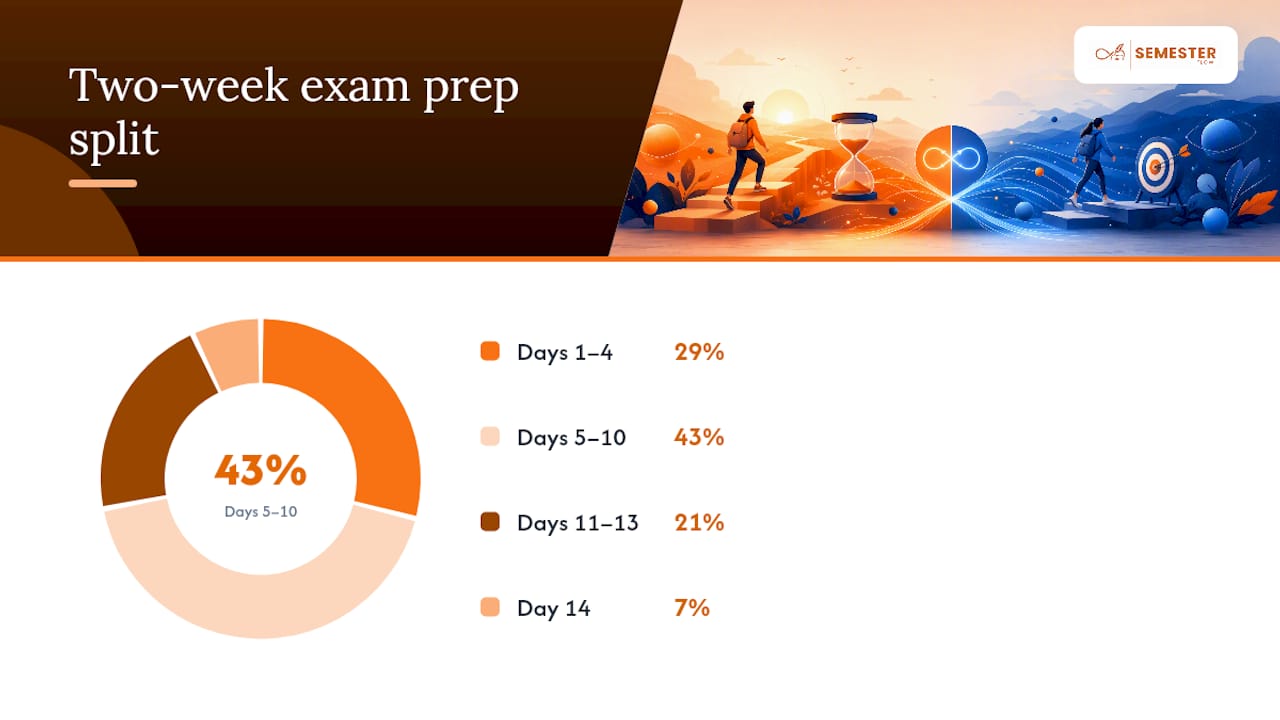
Here's a two-week exam prep template that puts that research to work:
- Days 1 to 4: Convert lecture notes into questions using a Cornell-style format, reviewing each set within 24 hours, as recommended by UNC's Learning Center.
- Days 5 to 10: Space out three short practice-test sessions rather than one long cram session.
- Days 11 to 13: Redo only the questions you missed.
- Day 14: Light review, early sleep, no new material.
Weekly, block three study sessions of 25 to 50 minutes with short breaks (the Pomodoro approach used by Oregon State's success center) rather than one marathon session. Show up to every office hour you can. And guard your sleep: multitasking and sleep loss both measurably reduce learning efficiency, according to Cleveland Clinic research on attention and cognition.
Which Campus Resources Actually Move Your GPA?
You're paying for these already. Use them.
- Tutoring and supplemental instruction for your highest-credit at-risk course.
- The writing center for any paper worth more than 10% of a grade.
- Academic advising, prepared with your GPA worksheet, current syllabus list, and a specific question about retake or withdrawal timelines.
- Counseling services if stress or anxiety is driving missed deadlines, not just poor understanding of the material.
Before that advising meeting, SNHU recommends mapping your actual non-negotiables onto a calendar first, so the conversation is about strategy, not just venting about being overwhelmed.
- Withdrawals, pass/fail options, and retakes each interact differently with financial aid and satisfactory academic progress. Confirm every deadline before you act.
- If this semester is already too far gone, a lighter course load or a summer retake often beats overloading next term to compensate.
How Semester Flow Helps You Track and Hit Your GPA Goal
Most GPA damage happens quietly. Semester Flow reads your uploaded syllabus and pulls every assignment, exam, and deadline straight into Google Calendar, so nothing small slips through.
- Syllabus parsing means fewer missed due dates because the deadlines are already on your calendar, not buried on page six of a PDF.
- Grade goal projections show you exactly what score you need on the next exam to hit your target course grade.
- Per-class profiles flag a slipping grade early, before it becomes a GPA problem you're managing in week 14.
| What you get | Why it matters for your GPA |
|---|---|
| Automatic deadline sync | Fewer missed low-stakes points |
| Real-time GPA tracking | Know your number without manual math |
| Grade projections | See the exact score needed on what's left |
| At-risk alerts | Catch a slipping class in week 3, not week 13 |
See how the grade projection feature or per-class grade profiles work if you'd rather automate the tracking than run the math by hand every week.
Why Consistency Beats a Heroic Comeback
Students ask me how fast they can turn a bad GPA around, and the honest answer disappoints most of them: one strong semester moves the number, but it doesn't erase the last three. Real recovery is a multi-term project, and pretending otherwise sets you up for burnout by week nine.
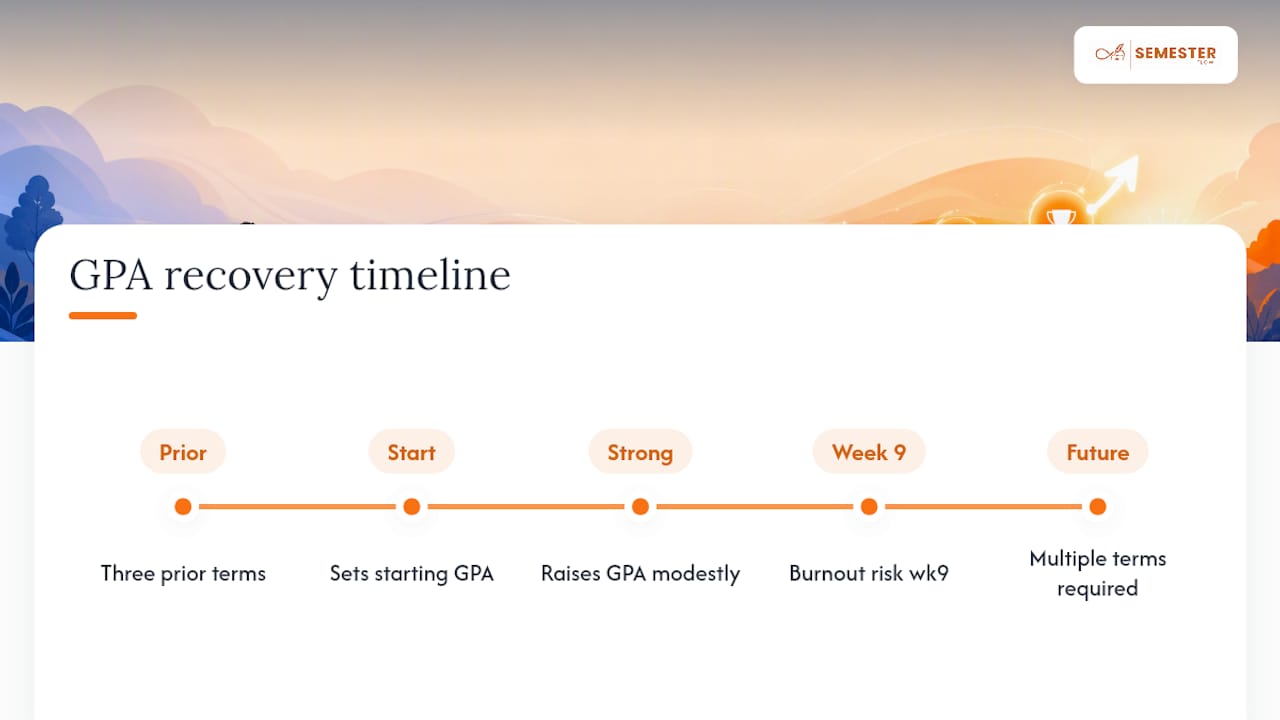
What works instead is boring and repeatable. Build a weekly system, hold yourself accountable to it, and forgive yourself when a week goes sideways. Sustained GPA improvement comes from consistent routines, not last-minute sprints, according to Dickinson College's advising guidance, and that tracks with what actually happens on most campuses.
If you take one thing from this article, make it this: run your GPA diagnostic today, and book an office hour slot before the week ends. Everything else builds from there.
— Haden
Quick Links for GPA Calculators and Academic Support
Run your own numbers or check policy details directly:
- Research.com's GPA guide for a full breakdown of GPA math and improvement strategies.
- SNHU's success guidance for time-management and advising tips.
- Graduate honor society thresholds if you're targeting a specific GPA benchmark.