
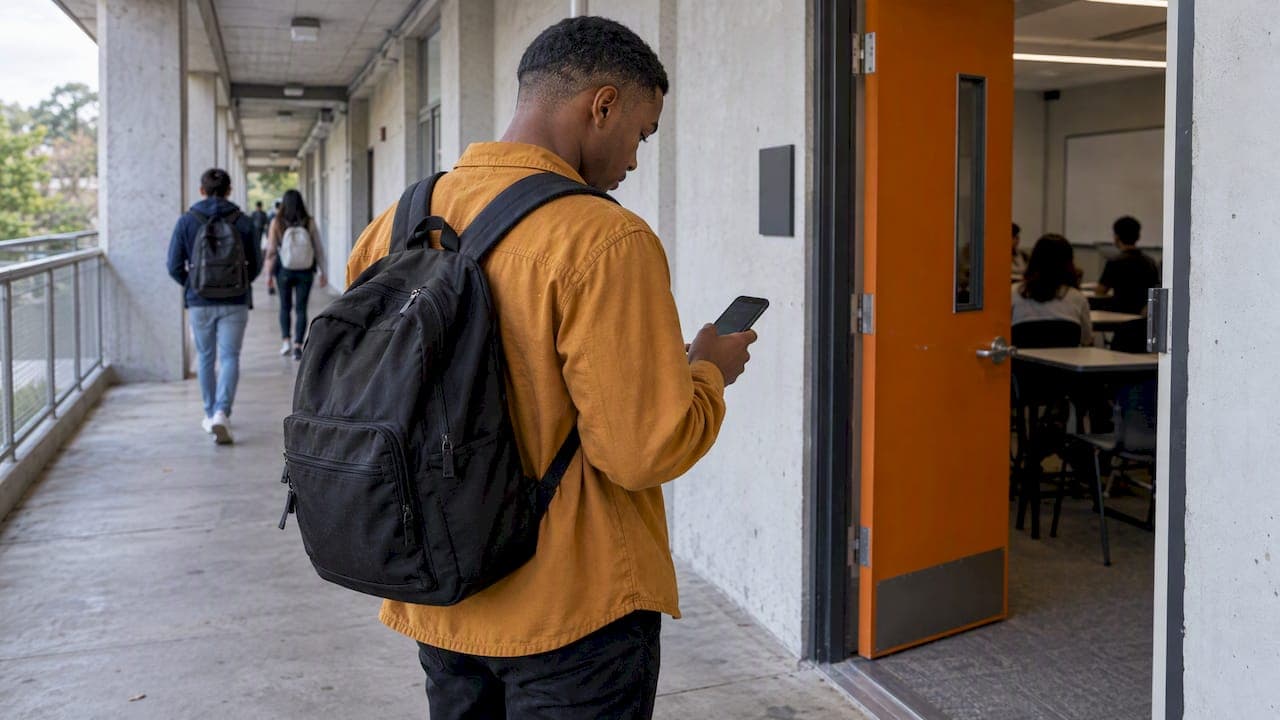
A hybrid class schedule is a course with two required parts: a meeting pattern on campus and a meeting pattern online. The online part may run at set live times or on your own time, and the registrar's listing often shows only part of the picture. Read both patterns the day you register, put every required hour on your calendar, and treat the online hours like appointments you cannot move.
This guide shows how to read a hybrid listing, what the workload really is, how to build a sample week, and how semester and quarter calendars change the math.
TL;DR
- A hybrid course has an on-campus meeting pattern and an online one. The online one can be synchronous (live) or asynchronous (no set time), so check the syllabus for hidden live sessions.
- Fewer hours on campus does not mean less work. The credit-hour standard still assumes about two hours of out-of-class work per credit hour each week.
- Block asynchronous hours as fixed appointments. Leaving them as "do whenever" tasks is how deadlines pile up on Sunday night.
- Quarter terms run about 10 weeks and semesters about 15, so a hybrid course moves faster on a quarter calendar.
- Pull every date from every syllabus into one calendar in the first week.
Table of Contents
- What a hybrid class schedule actually is
- Read the two meeting patterns
- Synchronous or asynchronous: what each means for your week
- The workload is the same, only the location changes
- A sample hybrid week
- Avoiding the Sunday-night pileup
- Stay visible to your instructor
- Quarter vs. semester: how the calendar changes a hybrid course
- Perspective: why hybrid is a calendar problem
- Put your hybrid schedule on one calendar
- FAQ
- Sources
What a hybrid class schedule actually is
There is no single national format. Schools define "hybrid" differently. Southern Connecticut State University asks for at least 50% in-person instruction, while the University of North Florida counts a course as hybrid at a lower in-person share. Other schools sort hybrids by how much is online. Penn State's registrar, for example, lists three tiers: 25 to 50%, 51 to 74%, and 75% or more online.
So the same word can mean very different weeks. One hybrid might meet on campus once a week and do the rest online. Another might meet in person every other week. A third might have a lab on campus and lectures on video.

Many schools now label this in the course search. The University of Washington, for instance, defines hybrid as regular interaction both in a physical classroom and online, through required live sessions or required asynchronous activities. Look for that label before you assume anything.
Read the two meeting patterns
On many registrar systems, a hybrid course lists two rows. One has a building, room, days and times. The other is coded something like "Web" or "TBA." Penn State's registrar notes that the web row does not tell you whether the online part is live. A hybrid can include mandatory Zoom meetings at a fixed time.
Do this within the first 48 hours after you register:
- Open the course listing and write down both rows, including the room and the time zone for any online meeting.
- Open the syllabus and search for "synchronous," "Zoom," "live," "attendance" and "proctored."
- Email the instructor if the syllabus and the listing disagree. Ask which sessions are required.
- Check whether exams are on campus even when most of the course is online.
- Add everything to one calendar before the first class.
A TBA row is not a free pass. It means the time is not fixed in the registrar system. The instructor may fix it later or never fix it, because the work is asynchronous.
Synchronous or asynchronous: what each means for your week
| Synchronous online | Asynchronous online | |
|---|---|---|
| Set time | Yes, live at a scheduled hour | No, deadline-based |
| Typical activity | Video lecture, discussion, group work | Recorded lectures, forums, quizzes, readings |
| Main risk | Missing a live session or a time zone slip | Putting it off until the weekend |
| Best calendar habit | Treat like an in-person class | Block a recurring work window |
The asynchronous hours are where hybrid students struggle. Research on synchronous hybrid learning points to intentional engagement: students who treat online hours as immovable appointments tend to do better than those who treat them as flexible. The same research names the typical pitfall as leaving asynchronous work out of weekly planning, which creates a deadline pileup at the end of the week.
The workload is the same, only the location changes
Students often assume hybrid means lighter. The credit-hour standard says otherwise. The University of Florida's course design office describes a credit hour as about one hour of instruction plus at least two hours of out-of-class work per week across a 15-week semester. In a hybrid, the instruction hour is split between seat time and online activity, but the total expectation stays.
Frederick Community College's seat time guide gives a concrete example: a three-credit class meets 2 hours 30 minutes a week and expects 75 hours of outside work over the term. Your school's numbers may differ, so check its own policy.
Here is what that means for one three-credit hybrid course, using the standard's 1-plus-2 pattern:
- 1 hour of instruction-equivalent time, split between campus and online
- 2 or more hours of reading, assignments and studying
- About 3 hours a week in total, and more in an intensive term
Five hybrid courses at that level add up to about 15 hours a week. Hybrid does not shrink that. It only moves the hours around.
A sample hybrid week
Take a student with four courses: two hybrid, one fully in-person and one asynchronous online. They also work 15 hours a week. This is an illustration, not a prescription.
| Day | Block | What goes there |
|---|---|---|
| Monday | 10:00 to 11:15 | In-person: Hybrid Course A |
| Monday | 7:00 to 8:30 pm | Asynchronous work for Course A (modules) |
| Tuesday | 2:00 to 3:15 | Live online session: Hybrid Course B |
| Wednesday | 10:00 to 11:15 | In-person: Course C |
| Wednesday | 7:00 to 8:30 pm | Course B asynchronous work |
| Thursday | 12:00 to 1:30 | Course D asynchronous videos and quiz |
| Friday | 3:00 to 5:00 | Weekly review and plan for next week |
| Sunday | 4:00 to 5:30 pm | Buffer for anything that slipped |
Three habits make this work. First, every online block has a start and end time, just like a class. Second, asynchronous work lands early in the week, not on the due date. Third, one weekly review turns the syllabi into a to-do list. If you want a template, our guide to a weekly review that beats cramming walks through it in 20 to 60 minutes.
If you work, the same logic applies with tighter margins. Our weekly system for working students shows how to fit study blocks around shifts.
Avoiding the Sunday-night pileup
A pileup rarely comes from one big assignment. It comes from five small online tasks that all close on Sunday at 11:59 pm: a discussion post, a quiz, a reading response. Each looks small, and together they fill the day.
Try these fixes:
- Set your own deadline. Put an internal due date on Thursday or Friday for anything the course closes on Sunday.
- Block recurring windows. Two or three fixed online-work blocks per course beat an open promise to do it later.
- Batch similar tasks. Forum posts, quizzes and short responses can go together. See our assignment batching templates.
- Space your study. Reviewing material in short sessions across the week works better than one marathon. A guide on building a weekly study schedule that holds covers how to set up recurring review windows.
- Count the commute. If an in-person day follows a late online session, protect travel time and sleep.
Stay visible to your instructor
Grades in hybrid and in-person courses tend to look similar. A study published in the Journal of Political Science Studies found no significant effect of modality on GPA at a selective liberal arts college. The same paper reports that a 2019 community college study found blended remedial math models cut pass rates by 10 percentage points when not properly supported.
The same source notes that students in online and hybrid sections often report a lower sense of connection to the institution and lower satisfaction with teaching. With less face time, your instructor sees you less. Introduce yourself in week one, go to the first office hours, and ask one question in the first live session. It costs little and makes it easier to ask for help later.
Quarter vs. semester: how the calendar changes a hybrid course

Most U.S. colleges run semesters of about 15 weeks, while quarter schools split the year into three or four terms of about 10 weeks, according to BestColleges. The same source says semester courses are usually worth three or four credit hours and quarter courses two or three.
What that means for hybrid scheduling:
- Quarter terms compress everything. If a hybrid has one live session a week, you have roughly ten of them, so one missed session is a larger share of the course.
- Semester terms give you slack. More weeks means more time to recover, but also more weeks for asynchronous work to slip.
- Shorter terms raise the cost of a late start. Some schools run 8-week or 5-week hybrids. A community college study compared a five-week intensive hybrid with an 11-week traditional format to explore broader access.
- Credit-hour math differs. A quarter credit is a smaller unit than a semester credit, so compare workloads by weekly hours, not credits alone.
In an accelerated hybrid, plan by days, not weeks. A weekly module in a 15-week course may be due every three or four days in an 8-week one.
Perspective: why hybrid is a calendar problem
We built Semester Flow because the hard part of college is rarely the content. It is the administrative load of tracking what is due, when, and where. Hybrid courses make this worse, because the information lives in three places: the registrar listing, the syllabus and the learning management system. Those three places do not always agree.
Our view is simple. A hybrid schedule is only as good as the calendar it lives on. Students who tell us they feel behind in hybrid classes usually are not lacking effort. They are missing a single view of every required session and deadline. Researchers and academic planners say much the same: flexibility raises the cognitive load of scheduling management, so students have to manage their own syllabi actively.
That is why we let you upload a syllabus, including a photo, and have the AI pull out class meetings, assignments and exams and sync them to Google Calendar. Then the live Zoom session in week six is on your calendar, not buried in page four of a PDF. If a grade starts to slip, you see it early, with a projection of what you need on the rest of the term.
— Haden
Put your hybrid schedule on one calendar
You can do this by hand. Copy every date from every syllabus into a calendar, add reminders, and update it when instructors change something. It takes a few hours at the start of the term and is worth every minute.
If you would rather skip the typing, Semester Flow reads the syllabus for you and syncs to Google Calendar. Pro is $7.99 per month, the Parent plan is $15 per month, and there is a free trial so you can test it on one syllabus first. Organization plans for chapters and groups are also available on the pricing page.
A few guides to go with it:
- How to get your class schedule into Google Calendar
- Combine multiple syllabi into one master schedule
- Track college assignments without typing dates
- Build a semester plan that holds up
- Manage college deadlines with syllabus sync
When exams come around, the same calendar feeds your finals week plan.
FAQ
Does a hybrid class mean I have to go in person?
Yes, at least some of the time. A hybrid course has a required on-campus component with set days, times and a location. How often you attend varies by school and course, so check the listing and syllabus. Fully online or HyFlex options are labeled differently, and HyFlex lets you choose how to attend.
Are hybrid classes easier than regular classes?
Not by workload. The credit-hour standard expects about the same total time on a hybrid as on a traditional course, only split differently. Research found no significant GPA effect from modality alone, so results depend on how engaged you are. Many students find the self-management harder, not easier.
Are the online parts of a hybrid class live?
It depends on the course. The online meeting pattern can be synchronous, with set live times, or asynchronous, with no set time. A "Web" or "TBA" row in the registrar does not tell you which. Read the syllabus in the first week and ask the instructor if it is unclear.
Is a quarter or semester schedule better for hybrid classes?
Neither is better for every student. Semesters, at about 15 weeks, give more time to recover from a slip. Quarters, at about 10 weeks, move faster and make each missed session count for more. Pick based on how you manage pacing and how heavy your outside commitments are.
Sources
- Southern Connecticut State University: Online Teaching and Learning Standards and Policies
- Penn State Office of the University Registrar: How to Schedule Hybrid Courses
- University of Washington Registrar: Course Modes and Definitions
- University of Florida CITT: Considering Student Workload
- Frederick Community College: Seat Time Guide
- Synchronous hybrid learning research, Journal of Science Education and Technology
- Journal of Political Science Studies: course modality and performance
- Montgomery College: Comparing Effectiveness of Intensive Hybrid and Traditional Course Formats
- BestColleges: Semester vs. Quarter System in College